When Fiat bets on advertising boldness
Everyone has seen an advertisement promising to “enlarge something”… or a humorous scene where Michael Youn swallows Viagra in The 11 Commandments.
But what if these two worlds collided? This is exactly what Fiat dared to do in 2015 with its advertisement for the Fiat 500X, aired during the Super Bowl, the most-watched television event in the world.
Behind this nod to the famous “blue pill” lies a bold, funny, and visually polished communication campaign — but also a true marketing case study on the difficulty of adapting a European brand to the American market.
A Fiat advertisement like no other: from Viagra to the Fiat 500X
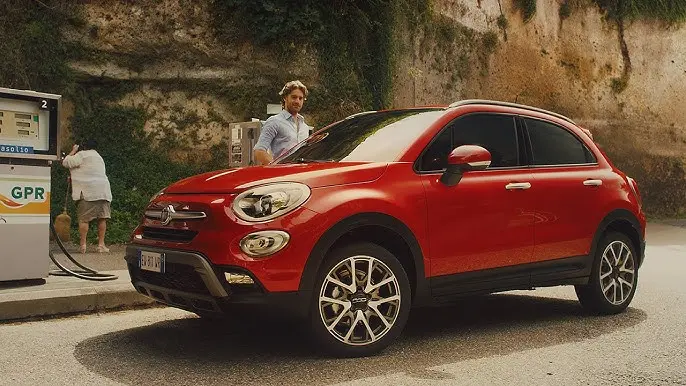
The advertisement opens in a peaceful Italian town perched on a cliff. A man, ready to join his partner, swallows a blue pill… well, he tries. Because it slips from his hands and begins a spectacular fall through the village's alleys: on laundry lines, in a bell tower, on the head of a monk, before finally landing in the tank of a small blue Fiat 500.
Result? The car instantly transforms into a larger, sturdier, more “masculine” model: the Fiat 500X.
A simple and effective message:Fiat took its iconic small city car and gave it power.
A humorous storytelling, supported by impeccable cinematic direction, typical of the Italian “Dolce Vita.”
A global launch orchestrated around the Super Bowl
Initially presented at the 2014 Paris Motor Show, the advertisement really took off in February 2015, during the Super Bowl.
Why the Super Bowl?
Because it is one of the most prestigious — and most expensive — advertising spaces in the world: nearly 4.5 million dollars for 30 seconds. Fiat wanted to gain global visibility and attract the American audience with plenty of humour and symbolism.
This broadcast was part of a 360° marketing campaign, combining television, web and social media, aimed at enhancing the awareness of the new model Fiat 500X, a crossover version of the famous Italian city car.

The marketing objective: to appeal to a challenging American market
Fiat had returned to the American market in 2011. But after a promising start, sales of the Fiat 500quickly fell. The observation is clear:
“The car is too small for the United States, the land of the Hummer and the Jeep.”
The 500X had to meet this need: to keep the Fiat DNA while adapting to the vast American spaces.
In other words,a larger, more muscular, more American Fiat.
The strategic idea was brilliant on paper: to transform the “chic little Italian” into a compact SUV, more in line with the expectations of the US market.

A creativity praised by the international press
On the media side, the advertisement created a real buzz.
Adweek described it as “one of the most incredible concepts we have ever seen”, while calling it “totally absurd”.
Autocar reported a standing ovation at the Paris Motor Show, praising “the humour and effectiveness of the gag”.
La Réclame highlighted “the juvenile humour and clichés of Italian seduction”, noting more than 370,000 views on YouTube in three days.
In Italy, ANSA talked about a “spot that is making waves on the web”.
And according to Inquisitr, the spot reached 3.4 million views in 24 hours after its airing at the Super Bowl.
In short, in terms of notoriety and virality, Fiat had succeeded in its gamble.
But a long-term commercial failure
Unfortunately, the viral success did not translate into sustainable sales.
In 2015, the 500X sold well in Europe (70,000 units, including 30,000 in Italy), but the American figures remained low:
9,463 sales in the United States,
609 in Canada,
and a constant decline in the following years:
→ 12,599 in 2016
→ 7,665 in 2017
→ 5,223 in 2018
By 2024, Fiat was selling only 1,528 vehicles in the United States, compared to over 500,000 Jeep.
In other words, the humour of the “blue pill” was not enough to sustainably revive the brand on American soil.
A marketing lesson: when creativity is not enough
This advertisement perfectly illustrates a major paradox of modern marketing :
“An advertisement can be brilliant, viral and acclaimed… without necessarily driving sales.”
The Fiat 500X campaign tried everything:
- an original storytelling,
- universal humour,
- a polished production,
- global distribution.
But it did not truly resolve the underlying issue:the product did not fully match the target market.
In the United States, consumers are looking for larger vehicles, with an image of power and safety. Even “enlarged”, the 500X was still perceived as a “cute” little Italian car, but not necessarily suited for long American roads.
What Fiat could have done differently
Several areas for improvement emerge:
A more in-depth market study to identify the specific expectations of the American public.
More local communication, focused on usage (families, outdoor, interior space).
Less suggestive humour, more emphasis on the model's strengths.
The gamble was bold, but the strategy did not fully convert curiosity into purchase.
Conclusion: an iconic campaign… but a mixed success
The “Viagra” advertisement for theFiat 500Xremains today a reference in communication and marketing schools.
It demonstrates that an ad can leave a lasting impression, make the whole world laugh, create a buzz… without necessarily transforming the brand image in the long term.
Fiat attempted to charm the American market with humour and boldness — an admirable approach, but one that also shows the limits of globalised marketing.
As it turns out, creating a good advertisement does not always guarantee a successful product launch.
It was also necessary for the car, like the famous blue pill,to truly deliver on its promises.